If you are hearing heavy thumping in your attic at night, you are not dealing with mice. Raccoons are significantly larger and louder and their movement through your attic sounds nothing like smaller pests. August and September are when raccoon attic entries across Toronto and the GTA spike as young raccoons from this spring become fully independent and start scouting denning sites before winter. Here is what Toronto homeowners need to know about raccoon removal before the damage gets serious.
Why Toronto Has a Raccoon Problem Unlike Any Other City
Toronto has one of the highest urban raccoon populations in the world with an estimated 100 raccoons per square kilometre across the city. That density is not an accident. Toronto’s combination of mature tree canopy, abundant food waste from green bin programs, and a housing stock full of aging soffits and roofline vulnerabilities creates ideal conditions for raccoons to thrive year round.
The spring and late summer periods are the two highest-risk windows for attic entry. Female raccoons seek warm enclosed spaces to give birth in late winter and early spring. The kits born in April and May spend the summer growing in the attic and by August they are mobile, foraging on their own, and beginning to identify their own denning sites for the coming winter.
Most homeowner insurance policies in Ontario do not cover raccoon damage, making prevention and early removal significantly less expensive than dealing with the full scope of structural damage after a family has established itself in your attic for a full season.
Signs You Have Raccoons in Your Toronto Attic
Heavy thumping and rolling sounds at night. Raccoons are nocturnal and most active between dusk and midnight. Their movement through your attic is noticeably heavier than mice or squirrels. If you are hearing loud footsteps, rolling sounds, and significant activity above your bedroom ceiling after dark, raccoons are the most likely explanation.
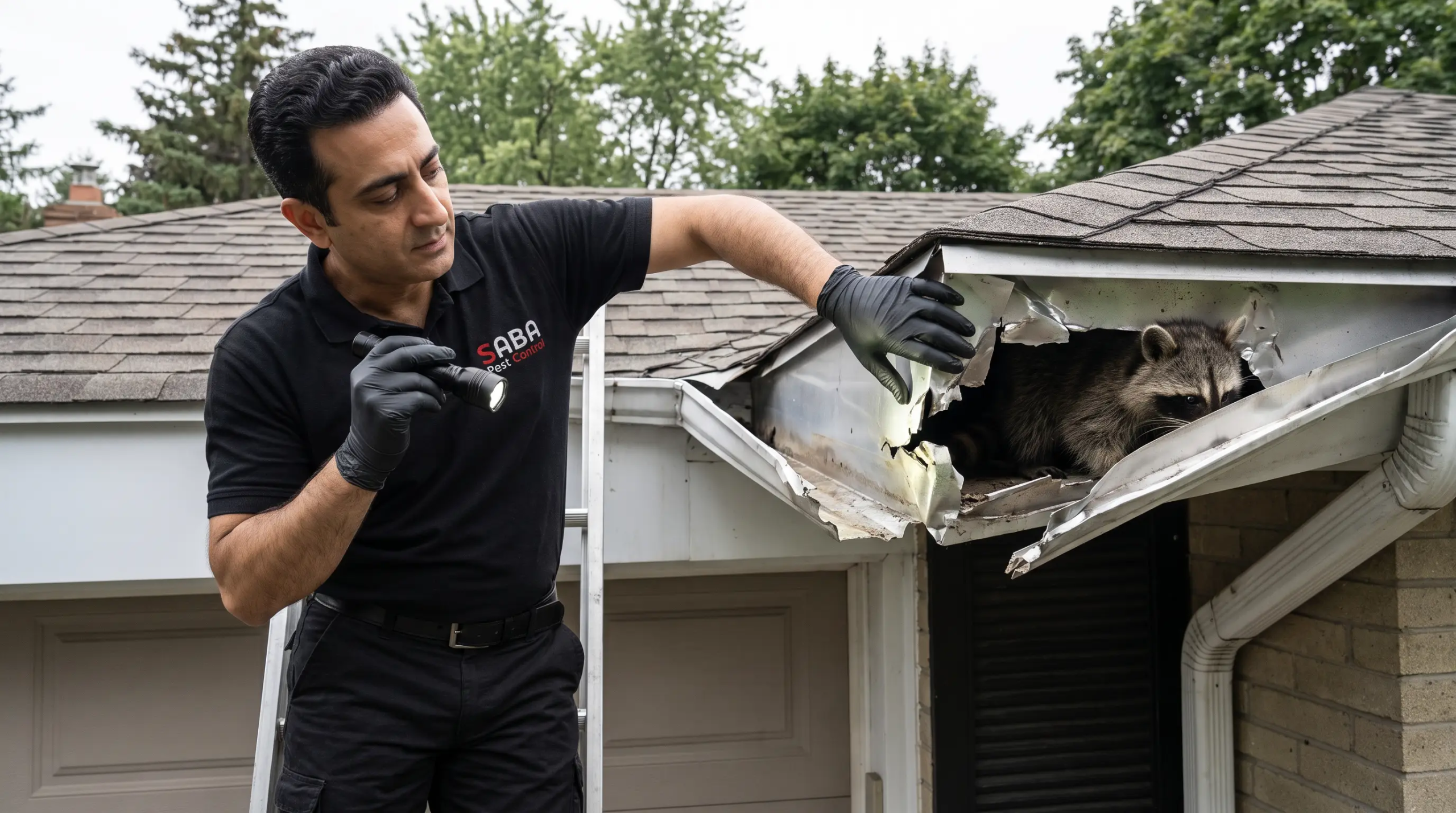
Torn or damaged soffit vents and fascia boards. Raccoons have paws that function almost like hands and can peel aluminum soffit panels, pop plastic mushroom vents off entirely, and pry open weak points in your roofline with surprising force. Visible damage around soffit corners, roof vents, and fascia boards is a reliable indicator of raccoon entry.
Raccoon droppings near the foundation or roofline. Raccoon feces are cylindrical, typically 5 to 7cm long, dark brown, and often contain undigested berries, seeds, or corn. Finding droppings near your foundation, on your deck, or near roofline entry points confirms raccoon activity on your property. Raccoon droppings carry raccoon roundworm which is a serious health risk.
Strong ammonia odour in the attic or upper floors. Raccoon urine accumulates in attic insulation over the course of a denning period. A persistent strong ammonia smell in upper floor rooms or in the attic itself indicates an established raccoon presence and may mean significant insulation contamination has already occurred.
Torn and displaced attic insulation. When raccoons enter an attic they immediately begin rearranging insulation to build a nesting area. If your attic shows insulation pushed aside, compacted into nesting piles, or visibly displaced across the attic floor, raccoons have been denning there long enough to establish themselves.
The Damage Raccoons Cause in Toronto Attics
A single adult raccoon can weigh up to 15 kilograms. A family of 4 to 6 animals living in your attic through a full season causes damage that accumulates quickly.
Insulation damage is the most common and most expensive consequence. Raccoons flatten, tear, and contaminate attic insulation with urine and droppings. Replacing contaminated attic insulation in a GTA home typically costs between $1,000 and $3,000 depending on attic size.
Electrical wiring is a serious concern. Raccoons chew on wiring throughout the attic, creating fire hazards that may not be discovered until an inspection is done after removal. Attic wiring repairs add significant cost on top of insulation replacement.
Roofline structural damage occurs when raccoons repeatedly enter and exit through the same points, expanding the opening over time and allowing water intrusion that leads to rotting fascia boards, damaged sheathing, and mould growth inside the attic cavity.
Why You Cannot Simply Seal the Entry Point
This is the most critical mistake GTA homeowners make when they discover a raccoon in their attic. Sealing the entry point without confirming all animals have left first traps them inside.
A trapped mother raccoon will tear through your roof, siding, or soffit to get back to her kits, causing significantly more damage than the original entry point. This happens consistently across Toronto every year when homeowners attempt DIY exclusion during spring and summer when kits are present.
One-way exclusion doors are the correct approach. A one-way door is installed over the primary entry point allowing raccoons to exit normally but preventing re-entry. After a confirmed period of no activity, the one-way door is removed and the entry point is permanently sealed with appropriate materials.
Under Ontario wildlife legislation, raccoons are protected animals and require humane removal methods. Lethal control of raccoons requires a permit from the Ministry of Natural Resources and is generally not applicable in residential situations.
What Professional Raccoon Removal Looks Like
At Saba Pest Control every raccoon removal job across Toronto and the GTA begins with a full roofline and attic inspection to identify all entry points, assess the extent of damage, and determine whether kits are present.
One-way exclusion doors are installed at all confirmed entry points. All secondary and potential entry points across the roofline are sealed simultaneously with heavy gauge galvanized steel mesh and metal flashing so raccoons cannot simply create new entry points when blocked from their original access.
After a period of confirmed vacancy, the one-way door is removed and the primary entry point is permanently sealed. We then assess the attic for insulation damage, droppings contamination, and wiring concerns and provide recommendations for remediation.
For full rodent and wildlife control including raccoons, squirrels, skunks, and wildlife exclusion across North York, Toronto, Scarborough, Vaughan, Markham, Mississauga, and all GTA areas, call (647) 867-7378 or visit sabapc.ca.
Preventing Raccoons From Entering Your Toronto Home
Trim all tree branches to at least 2 metres back from your roofline. Raccoons are excellent climbers and use overhanging branches as the primary route to your roof.
Install chimney caps on all open chimney flues. Uncapped chimneys are one of the most common raccoon entry points in older Toronto homes.
Replace all plastic soffit vents and roof vents with galvanized steel mesh-covered versions. Plastic vents are no barrier to a determined raccoon.
Secure green bins with bungee cords or raccoon-resistant lids. The standard Toronto green bin latch is not raccoon-proof on its own and a reliable food source near your foundation increases raccoon activity on your property.
Check and repair soffit panels annually, particularly at corner joints and where different building materials meet, before denning season begins in late fall.
Frequently Asked Questions
Is it legal to remove raccoons myself in Toronto?
Ontario wildlife legislation requires humane removal methods for raccoons. While there is no law preventing you from installing a one-way exclusion door yourself, sealing entry points incorrectly or trapping raccoons without following provincial guidelines creates legal liability. More practically, identifying all entry points and installing exclusion hardware correctly requires experience. Missing a single secondary entry point means the raccoon simply uses another way in.
How do I know if the raccoons have left after a one-way door is installed?
Monitor the one-way door for activity over 3 to 5 days. Check for fresh droppings inside and outside the attic. Listen for attic activity at dusk and pre-dawn. A thermal camera can also detect body heat in attic spaces where animals may be hiding. Our technicians confirm vacancy before permanently sealing any entry point.
Are raccoon droppings dangerous?
Yes. Raccoon droppings carry Baylisascaris procyonis, commonly known as raccoon roundworm, which is a parasitic infection that can cause serious neurological damage in humans if accidentally ingested or inhaled. Never sweep, vacuum, or disturb raccoon droppings dry. Wear a properly fitted respirator, disposable gloves, and protective coveralls. Professional attic decontamination is strongly recommended for significant contamination.
Can raccoons come back after the entry point is sealed?
Not through the same sealed entry point if it is done correctly. However new raccoons can create new entry points if roofline vulnerabilities remain. A full roofline inspection sealing all potential entry points simultaneously is the only approach that provides lasting protection. Raccoons also tend to return to properties where food sources remain available.