If you have a wasp nest on your property right now, August 29 is one of the worst possible days to ignore it. Wasp colonies across Toronto and the GTA hit peak population in late August and remain aggressive through September. A nest that was the size of a golf ball in June now contains hundreds or thousands of workers defending it at maximum intensity. Here is everything you need to know about wasp nest removal in Toronto before someone gets hurt.
Why August and September Are the Most Dangerous Months for Wasps
Wasp season in Toronto follows a predictable cycle. A single queen emerges from winter hibernation in April or May and begins building a nest from chewed wood pulp. Through June and July the colony grows steadily. By late August the same nest can hold thousands of workers and the colony is at peak aggression.
There is another factor that makes late summer worse. As natural food sources decline in September, wasps become more opportunistic and aggressive around garbage bins, outdoor dining areas, open drinks, and anything sweet. This is when most sting incidents across the GTA occur.
The 2026 Ontario wasp season has been particularly heavy. A milder winter let more overwintering queens survive and start bigger colonies going into spring, meaning many GTA nests this year are larger than average for this time of year.
The Four Wasp Species GTA Homeowners Deal With
Not all wasp nests look the same and the species matters for removal approach.
Paper wasps build open umbrella-shaped nests with visible honeycomb cells under eaves, deck railings, window frames, and door frames. They are moderately aggressive and only sting when the nest is directly threatened.
Yellowjackets are the most common and most dangerous species in the GTA. They build enclosed paper nests both aerially under soffits and eaves and underground in soil, wall voids, and abandoned rodent burrows. Ground nests are the most hazardous because they are difficult to spot and the colony responds with mass stinging to even minor vibrations nearby.
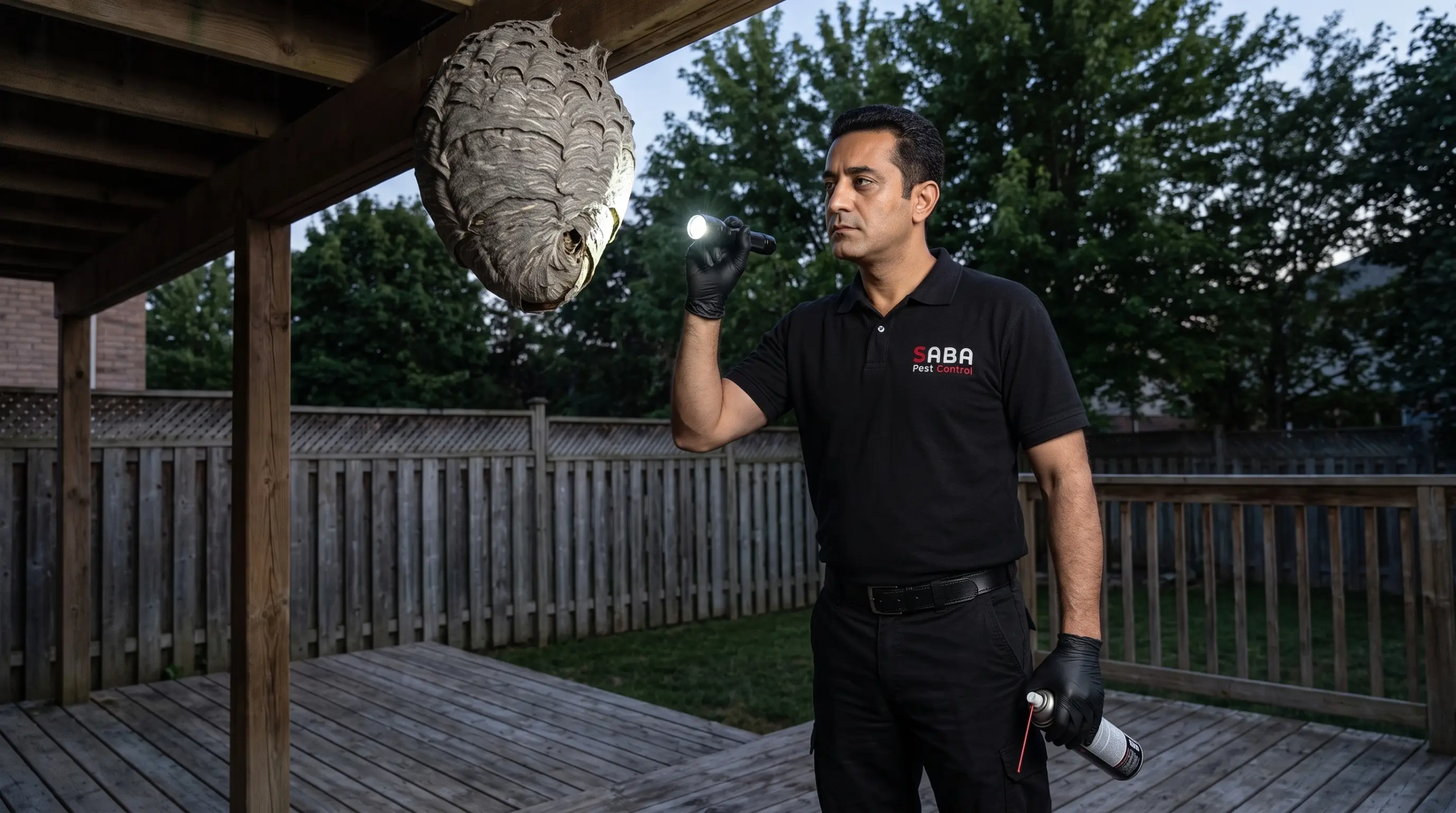
Bald-faced hornets build large distinctive grey football-shaped paper nests hanging from tree branches, shrubs, and building exteriors. They are significantly more aggressive than paper wasps and will pursue threats at distances of up to 3 metres from the nest.
Yellowjacket wall void nests are the most complex removal situation. When yellowjackets enter through a gap in your siding, soffit, or foundation they build inside your wall cavity where the nest is completely hidden. These require professional dust injection treatment through drilled access points.
Signs You Have a Wasp Nest on Your Property
The most obvious sign is seeing wasps repeatedly flying to and from a specific point on your home, in your garden, or on your property. Following the flight path of returning workers almost always leads directly to the nest entrance.
Consistent wasp activity concentrated around one area of your roofline or eaves with no visible nest suggests the colony may be inside a wall void or soffit. This is actually more urgent than a visible nest because hidden infestations are harder to treat and can result in wasps emerging inside your living space.
A hole in your lawn or garden with wasps flying rapidly in and out is a yellowjacket ground nest. Mark the location clearly and keep children and pets away immediately. Ground nests are the most common cause of serious stinging incidents because they are stumbled upon accidentally.
Why You Should Not Remove a Wasp Nest Yourself
Every summer across North York, Scarborough, and Mississauga we hear the same story. A homeowner tried to knock down a nest with a broom or sprayed it with a can of hardware store wasp spray and the entire colony attacked within seconds.
Store bought aerosol sprays have significantly lower concentrations of active ingredients than professional products and lack the residual power to kill the queen inside deep nesting cavities. Spraying an accessible nest typically kills the workers near the entrance while the queen and brood survive and rebuild.
Disturbing a yellowjacket ground nest without professional protective equipment triggers mass stinging from the entire colony. A single yellowjacket nest can deliver hundreds of stings within seconds. For anyone with a known allergy this is a life-threatening situation.
Bald-faced hornet nests require full professional bee suits due to the colony’s documented aggression at distances well beyond what most people expect.
Under the Ontario Pesticides Act, certain pesticide products used for structural wasp control are restricted for use by MECP licensed technicians only. Using restricted products without a licence is illegal regardless of what the pest control aisle at the hardware store offers.
When to Call a Professional for Wasp Removal
Call immediately if the nest is larger than a tennis ball, if it is located inside a wall void or underground, if it is near an entrance your family uses regularly, if anyone nearby has a known allergy to wasp stings, or if it is August or September when colonies are at maximum size and aggression.
At Saba Pest Control we treat all wasp and hornet nests after dark when the entire colony is inside and workers are significantly less active. This is the only safe and effective approach for full colony elimination in a single visit.
For insect control across all pest types in your GTA home, our licensed technicians are available 24 hours a day with a guaranteed 30 minute response time across North York, Toronto, Scarborough, Vaughan, Markham, Mississauga, and all surrounding areas. Call (647) 867-7378 or visit sabapc.ca to book a same-day inspection.
What Happens After a Wasp Nest Is Removed
Once a wasp colony is eliminated the nest itself is removed or treated and the entry point is sealed where applicable to prevent new colonies from using the same location.
One important fact most homeowners do not know: wasp nests are never reused. The colony that built this year’s nest will not return to the same nest next spring. However new queens that overwintered nearby are attracted to the same locations and attachment points by residual pheromones and will frequently build new nests in the same spots the following season.
Treating the attachment point with a residual product and sealing any gaps around soffits, vents, and utility penetrations is the most effective way to prevent returning colonies from establishing in the same location year after year.
Frequently Asked Questions
Will the city of Toronto remove a wasp nest from my property?
No. Municipal services in Toronto do not remove wasp nests from private property. Property owners are responsible for pest control on their own land under Toronto Municipal Code Chapter 629 which requires properties to be kept free of pests. If a nest poses an immediate life-threatening emergency involving a known allergic reaction, call 911. For all other nest removal call a licensed pest control company.
Do wasps come back to the same nest every year?
The same colony does not return. Wasp colonies die off every fall with only newly mated queens surviving to overwinter. However new queens frequently return to the same attachment points and general locations guided by residual pheromones. Sealing all gaps and treating attachment points after removal significantly reduces the chance of a new colony building in the same spot next spring.
How long does professional wasp nest removal take?
Most accessible nest treatments take 20 to 40 minutes. Hidden wall void treatments where dust needs to be injected through drilled access points take longer and require a follow-up inspection. Our technicians treat at night for maximum effectiveness and safety and confirm colony elimination before closing the job.
Is it safe to treat a wasp nest myself if I use a full-face shield and heavy clothing?
Improvised protective clothing is not equivalent to professional bee suits which are specifically engineered to prevent stings through sealed seams and appropriate materials. A bald-faced hornet colony or a large yellowjacket nest can deliver hundreds of stings simultaneously at force levels that penetrate regular clothing. The risk is not worth it when professional removal is available same day across the GTA.